
Experience Matters When it Comes to Tackling Tough Cases!
Contact Nacol Law Firm for help with Child Custody, Child Support, Child Visitation, Parental Alienation, Paternity, Interstate Jurisdiction, Property Division and Business Asset Protection.
Dallas Divorce Attorneys, Mark Nacol and Julian Nacol
Based in Dallas, Texas, the Nacol Law Firm PC, traces its roots to the firm of Mark A. Nacol and Associates PC, established in 1979. The Nacol Law Firm team shares its experience on a variety of legal topics here. See our recent posts below.


Texas Divorce / Texas Child Support Questions and Answers
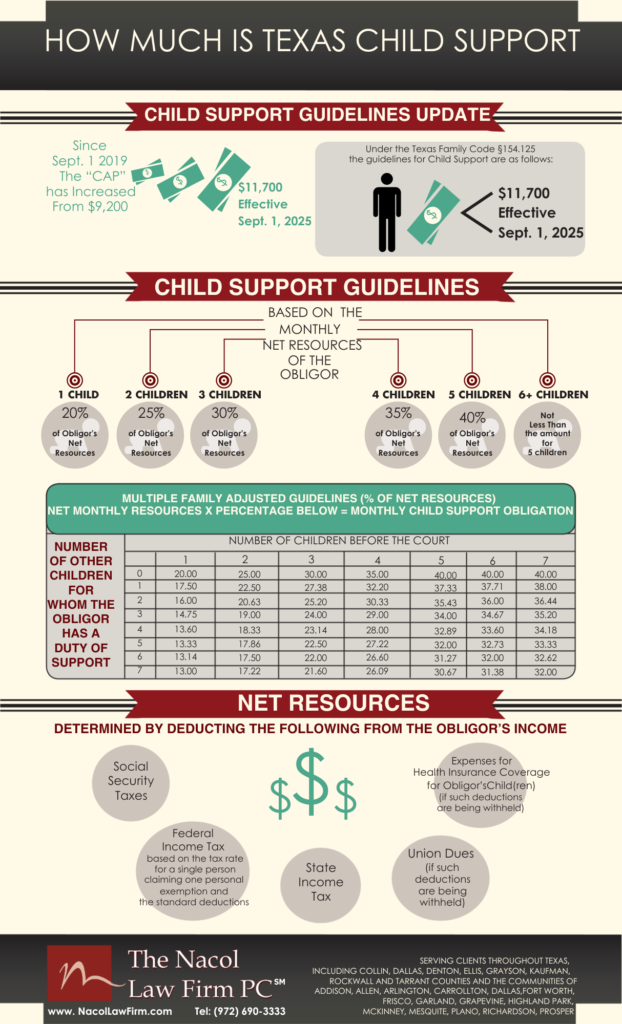
Q: How Much Is Texas Child Support ?
A: See our Infographic Below
Q: How long is the divorce process ?
A: In a Texas divorce there is a waiting period of a minimum of 60 days from the time you file the Original Petition commencing the lawsuit to the time the divorce may be finalized. Few divorces are finalized in this time-period. It is more likely that an uncontested divorce will take approximately 3 to 6 months and a contested divorce will likely will take much longer depending on the issues and conduct of the parties.
Q: Do my spouse and I both have to hire attorneys?
A: No. But it is certainly in your best interest to hire an attorney for a consultation purposes and to review legal documents for your own protection. An attorney should not in the vast majority of cases represent both parties, so if one attorney is involved he or she will under law be looking out for the best interest of the client that hired him/her, while the other party is representing themselves (pro se).
Q: Will I have to go to court?
A: If the spouses reach agreement, one party will have to appear in Court. Often times, when the parties have worked out their own settlement, that agreement is signed by each of you and submitted to the court with only one party making a personal appearance to state to the Court that the agreement has been reached and to establish statutory requirements. If, on the other hand, you and your spouse cannot come to an amicable settlement through this process, you will both have to appear in court, and often on many occasions.
Q: Should I Move Out of the Marital Residence?
A: Be sure to consult with an attorney before leaving the marital residence. Leaving the home may be viewed as abandonment or actually declaring a new residence, especially if you are taking personal items with you (clothing, automobile, sentimental possessions, etc.). If children are involved issues may arise as to who currently has or should have primary possession of the children. Once you have voluntarily left the home, it may be difficult to move back in or obtain orders for primary or temporary possession.
Q: How Do I Get a Divorce?
A: Before getting divorced you or you and your spouse should decide that you absolutely want and need the divorce. Even though in the divorce process prior to final judgment everything is reversible, it is important that you realize that the road is sometimes very long and can be a difficult one to travel.
Q: What if I Do Not Want a Divorce?
A: The advent of a divorce is something that slowly builds. You may want to consult with your spouse about placing things on hold while you receive counseling. However, the need for a divorce is rarely something that happens over night. Your spouse may have made his or her mind up long ago that divorce is the only option. If your spouse has filed for divorce, you have no choice. The most important thing for you to do if your spouse has filed for divorce is promptly seek proper legal advice.
If your spouse has significant assets and you feel they may be considering divorce seek legal advice immediately. You may want to do some pre-planning to make sure you have complete copies of original and final documents and know where all the marital assets are located and to assure their status. Do not give your spouse time to stash, spend away and/or hide assets.
Q: Can You Modify Child Support Orders?
A: Making changes to an existing child support order is not uncommon. Most states will not allow a request for modification on a child support order unless a time-period (of 2 to 4 years depending on the state) has passed since the order was put into place. Keep in mind that child support orders cannot be increased or decreased on a whim. In Texas, you must show a change in circumstances. However, if the person paying child support’s income has gone up or down more than 25% you can request a change. IMPORTANT NOTE: If you agree to no child support in your first order (Final Decree) and your spouse has a significant income at that time, you may have waived a statutory right to future child support unless the income level at the time of the existing order increases or decreases significantly.
Q: Can I Deny My Ex-spouse Visitation, Possession or Access?
A: You can not and should not deny visitation or possession, unless the Court has modified the visitation or possession to allow it! Denying visitation or possession is one of the biggest mistakes made by most primary custodial parents – it is an act of contempt in Texas. You may believe you have a justifiable reason for denying the visitation or possession rights, but by law your are not permitted to do so absent extraordinary circumstances, usually involving gross neglect or physical abuse.
Q: How Do I Get Custody of My Child(ren)?
A: The first and most important step to getting custody of your child(ren) is to be an involved and hands-on parent and to be honest. Being a great parent is not always the easiest task during divorce, but it is important to carefully consider each and every action you take during a divorce and how it may or may not effect the child(ren). You will also need good legal representation. Child custody issues can become ugly and complicated no matter how good your intentions may be. Make sure you are prepared. Document everything.
Q: What if I Do Not Like the Judges Decision?
A: The purpose of the ruling is to establish what exactly should be stated in the Final Divorce Decree. Once the attorneys have drafted the Final Divorce Decree and both parties have agreed that it coincides with the ruling, it will be presented to the Judge for signing. Once the parties have agreed and signatures are signed, you will have to live with the decisions. If the divorce is highly contested and the Judge rules and you are unhappy with the results, you have only a small window to appeal the decision or request a new trial.
Q: What is Fair Spousal Support or Alimony?
A: If you and your spouse can not come to agreement on the need for or amount of spousal support to be paid, the length of time, and under what conditions, the spousal support will most likely be set by a Judge according to Texas law.
Texas and Federal Confidentiality Laws: Use Caution with Your Texas Divorce
There are many legal and proper ways to obtain proof of a spouse’s infidelity. Take care to avoid tactics used to obtain private information that may violate federal and Texas confidentiality laws and a spouse’s right to privacy. You may be tempted by others to obtain proof of a partner’s infidelity by various inappropriate and/or illegal methods. Reading emails, recording telephone calls, installing spyware or geographical tracking devices or even setting up hidden cameras are just a few methods a spouse may be offered when entertaining the thought of catching a cheating spouse. However, such actions may expose both parties and their attorney to civil liability and possible criminal penalties. Under Texas law, it is a crime to install a geographical tracking device on a vehicle owned by another person. When emotions are running high, it is imperative that you seek proper counsel as to the proper legal action to be taken when establishing facts.
Both federal and state wiretapping laws apply to divorcing spouses. A spouse may sue the other spouse or their agents for invasion of privacy. Federal law regulates electronic surveillance of conversations and access to emails, faxes and voicemail. The law imposes civil and criminal sanctions for intentional interceptions of electronic communications. However, accessing email after it has been transmitted, i.e. downloading a text from your telephone or email from the hard drive of a family computer, is not an offense under the Federal Act. Texas has laws that also prohibit the interception of communications. Under such laws, counsel may also be held liable if they disclose information received from the intercepted communications provided by their clients.
Federal and Texas laws both allow recording of telephone calls and other electronic communications with the consent of at least one party to the communication. Under the one-party consent statutes, a spouse may record conversations in which he or she is participating. This has been extended to include parental recording of a child’s conversations with a third party, including the other parent. The parent can consent to the recording on behalf of the child so long as the parent has a good faith objective and a reasonable belief that it is in the best interest of the child, even if the child is unaware of the recording.
It is important that a spouse take great care in their means and methods of gathering information. Information obtained by illegal means can expose one, even if he or she is a spouse, to civil liabilities and possible criminal prosecution. Texas recognizes that every person has a certain right to privacy. Such right is violated if a person intentionally intrudes upon the private affairs of another by offensive means. Accessing stored email or secretly recording a spouse can be a violation of a spouse’s right to privacy. If a suit is filed, the damaged spouse may recover monetary damages, including punitive damages.
For answers to your questions on gathering information for your Texas Divorce, contact Dallas Divorce attorney Mark Nacol with the Nacol Law Firm, P.C.
NACOL LAW FIRM P.C.
8144 Walnut Hill Lane
Suite 1190
Dallas, Texas 75231
972-690-3333
Office Hours
Monday – Thursday, 8am – 5pm
Friday, 8:30am – 5pm
OUR BLOGS

SEARCH
JOIN OUR NETWORK

Attorney Mark A. Nacol is board certified in Civil Trial Law by the Texas Board of Legal Specialization