
Interstate Jurisdiction: Multi State Confusion in Child Custody Disputes
Child custody issues can be difficult for the parties involved at any time, but when the custody case crosses a state line, many more conflicts and problems may arise.
Most states follow a uniform law regarding determination of appropriate state jurisdiction in custody matters known as the Uniform Child Custody Jurisdiction and Enforcement Act (UCCJEA), and related statutes laws which enforce or set procedures regarding proper jurisdiction such as the Parental Kidnapping Prevention Act. Texas has adopted these statutes. The Uniform Child Custody Jurisdiction Enforcement Act defines which state has or may maintain jurisdiction in a particular case and often mandates that other states recognize decisions handed down by the state determined to have jurisdiction.
The Act states, among other things, that a court may rule on custody issues if the Child:
- Has continually lived in that state for 6 months or longer
- Was living in the state before being wrongfully taken elsewhere by a parent seeking custody in another state
- Has an established relationship with people (family, relatives or teachers), ties, and attachments in the state
- Has been abandoned: or is safe in current state, but could be in danger of neglect or abuse in the home state
There are a number of core factors involved in determining which state is appropriate to initiate or maintain an existing suit. Usually, there are only two states involved, but it is possible to have more than two states involved in cases where there is a frequent moving of the parties and or the children. Generally, any state in which one of the parties and the child has continually resided for a year may establish venue to commence a lawsuit.
At the Nacol Law Firm PC, we represent parents trying to enforce these laws; cases where we try to persuade courts to apply the specific, narrow exceptions to these general rules in order to have child custody cases heard in the most convenient forum in which the most evidence is available; cases where the child’s home state or other basic questions need to be clarified, and cases where a parent has violated or has been falsely accused of violating these laws.

Getting a Texas Divorce : Moving Out of the Marital Home
This is a complicated question to answer depending upon the facts of each case. If you have experienced domestic violence you need to immediately do whatever is necessary to secure you and your child’s safety. Many times a victim will go to court for a protective order and ask the judge to move the abusive or violent spouse out. In this situation contact an experienced family law attorney now!
In most cases, absent of violence or risk of abuse, we would not suggest that a spouse move out of the marital residence.
Why is this? One reason is once you have vacated the residence it may be very difficult to get back in! You have no legal obligation to leave the residence if your name is on the lease or mortgage personally and exclusivity.
Our suggestion to a client might be, to remain in the residence since the person who vacates may still have financial obligations and expenses of the family residence, while paying all expenses on a new residence for themselves. Double expenses are not a desirable result during the divorce process.
The higher wage earning spouse who moves out of the marital home must expect to continue to pay most of the household expenses, including the insurance and mortgage! What about the personal property and furnishings in the residence?
If an agreement has not been made between the divorcing couple, the moving spouse will generally only be able to leave with personal belongings (clothing & jewelry) until a court rules fairly as to temporary possession.
Secure a court order ASAP to equalize property and household expenses.

Going Through a Texas Divorce with a Special Needs Child
Going through a divorce can be a difficult time for all family members, including the children. The stress of dealing with a child that has a serious illness or difficulty prior to the initiation of a divorce may accelerate during the divorce process. We call such a child the “Special Needs Child”. This child has apparent or diagnosed emotional/medical problems.
Special Needs children are seriously impacted by the decisions made during a divorce. Many times the child becomes more vulnerable not knowing with is happening but very afraid of losing mom or dad forever and causing additional emotional and behavioral problems at home. It is important for parties to determine how meaningful regular visitation will be accomplished and which parent will have the right to make major decisions on how to address the child’s emotional and medical needs. During a divorce, most parents have difficulty agreeing on issues, especially issues related to the problems associated with a “special needs” child.
I. Child with Emotional Issues:
Children will always experience some level of negative emotions during the divorce process, even in the best circumstances. When a child has a mental illness or emotional problem, how visitation periods are managed, who has the authority to make a decision on medical treatment and therapy and how such decisions will be followed and enforced in each parent’s household will greatly affect the success or failure of the final decree as it pertains to the child. It is very important to have an order that is flexible and meets the child’s changing needs, yet remains enforceable should action need to be taken due to a parent’s failure to meet the needs or comply with the court’s order.
Three of the most reported emotional and behavioral issues involving children are Attention Deficit Hyperactivity Disorder (ADHD) Behavioral or Conduct Disorders, Oppositional Defiant Disorder (ODD), and chemical addictions.
2. Special Medical Needs
When a child has significant medical health problems or disabilities parents may have very different opinions on who should be the decision maker regarding doctors, medications and regimens for a particular situation. This may be compounded by the emotions and breakdown in the marital relationship often caused by the stress and differing opinions of the parents on the care of the child. The Court must help to balance the needs and rights of the parents so that each has a voice in their child’s treatment decisions. It is also important that the parties along with the Court work for a consistent treatment protocol to meet the child’s medical needs and best interests.
The real battleground in Texas custody cases becomes the allocation of rights and duties between the parties. This is exacerbated when the child involved has emotional or medical needs. Other factors that may compound issues are 1) other children involved and 2) whether they also have special needs. Major problems occur when there are differing views between the parents on how to best treat the problem or a lack of consensus among medical and mental health professionals as to the appropriate protocol for treatment and uncertainty among family courts as to which protocol
to “impose” upon the family.
Texas Courts vary greatly on how each allocates rights and duties, even in joint managing conservatorship situations. In the event the parties cannot agree on the allocation of rights pertaining to educational and medical decisions the courts must award custody based on the principle of what is the best interest of the child. The Court will consider many factors in developing a parenting plan including the development status of the child, the child’s temperament, and each child’s specific needs.
To make a meaningful decision on the care of the child, the court will need evidence of the following:
• Which parent is the most involved in the decision making as pertains to the relevant issue?
• What are the competing theories of how to best treat the child?
• Current opinions from the child’s physician and /or therapist.
• What is the generally accepted treatment for the specific condition?
• What is the likelihood of each parent following the protocol selected by the court?
• How successful has the treatment been in the past?
• What are the attitudes of the parents in relation to considering alternative methods if the current situation doesn’t work?
• Which parent has shown a proven effort at recognizing the child’s needs and working to address them?
The selection of a reputable expert in the particular field in which the child is affected is paramount to a true evaluation of the situation. Not all doctors and therapists are created equal and the expert must be a specialist in working with the child’s specific problem.
After the divorce is concluded, raising a special needs child requires a high degree of collaboration between both parents. This child feels very afraid and doesn’t have to be put in the middle of a parental alienation feud which could cause long term mental and physical scarring for both the child and the parents.
Parents, think about your child! Your child didn’t ask for a divorce but they will have to live with the consequences, good or bad, that your decisions leave them!

High Asset Divorces: Jury Trial on Assets
When two individuals have substantial assets and are resolved to file a Divorce, it is important to understand what a jury can and cannot determine regarding the assets or fault in the marriage. The strategy to request a jury trial or trial before a Judge can be complicated and vary greatly depending on the circumstances of the case.
- What can a Jury determine regarding marital property and fault between the parties.
-
- A jury trial may be requested by either party when a divorce is filed. Tex. Fam. Code §6.703
- If requested, a jury alone decides whether contested assets/marital property will be characterized as either (1) community or (2) separate. In re Marriage of Moore, 890 S.W.2d 821, 834 n.7; 838 (Tex. App.–Amarillo 1994, no writ); Archambault v. Archambault, 763 S.W.2d 50, 51 (Tex. App.–Beaumont 1988, no writ).
- A jury may decide the issue of fault in the marriage i.e. (adultery, cruelty, etc.)
- A jury may decide disputed issues regarding spousal maintenance such as: (1) eligibility for spousal maintenance, (2) dollar amount needed to provide spouse with minimum reasonable needs, and (3) the amount of time reasonably necessary for a spouse to become self-supporting.
- A jury may decide reasonable and necessary attorney’s fees for either side.
- A jury fee must be paid for following a request made by the court’s local rules.
2. What can a Court determine regarding marital property and fault between parties?
-
- A Court/Judge determines the just and right division of the martial estate when distributing or dividing the martial property.
- The Court/Judge take the Jury’s findings of fault and characterization of assets (separate or community) then determines what a just and right division of the property is proper in each specific case.
3. Things to consider regarding presenting evidence to Judge and Jury.
-
- Expert witnesses likely will be discussing whether property is separate or community (forensic accountants, business evaluators, title searches, appraisers, etc.).
- The jury determination of 10 out of 12 jurors is needed to determine: (1) the character of the property (separate or community), (2) find fault in the marriage, (3) award reasonable and necessary attorneys fees to either side.
- Costs and expenses for a jury trial are substantially more than a trial before a judge.
- A jury may make advisory opinions as well, that are not required to be followed by a judge, such as fraud on the community estate, distribution percentages of community property, and others.
There are many reasons during a high asset divorce a party may request a jury. Perhaps the Judge is unfavorable to an individual; perhaps the facts supporting separate property are not will be more favorable to a group of peers than a judge; perhaps adultery is a serious issue and may lead to a higher award of attorney’s fees and spousal support in the hands of a jury. It should be noted that if a jury is to determine a plethora of issues to make an educated determination to whether property is separate or community property then there will require many experts and simplification of the issues should be paramount.
Dallas High Asset Divorce Attorneys
Nacol Law Firm P.C.
(972) 690-3333

Texas Child Support Guidelines – How Much is TX Child Support?
UPDATE ON TEXAS CHILD SUPPORT:
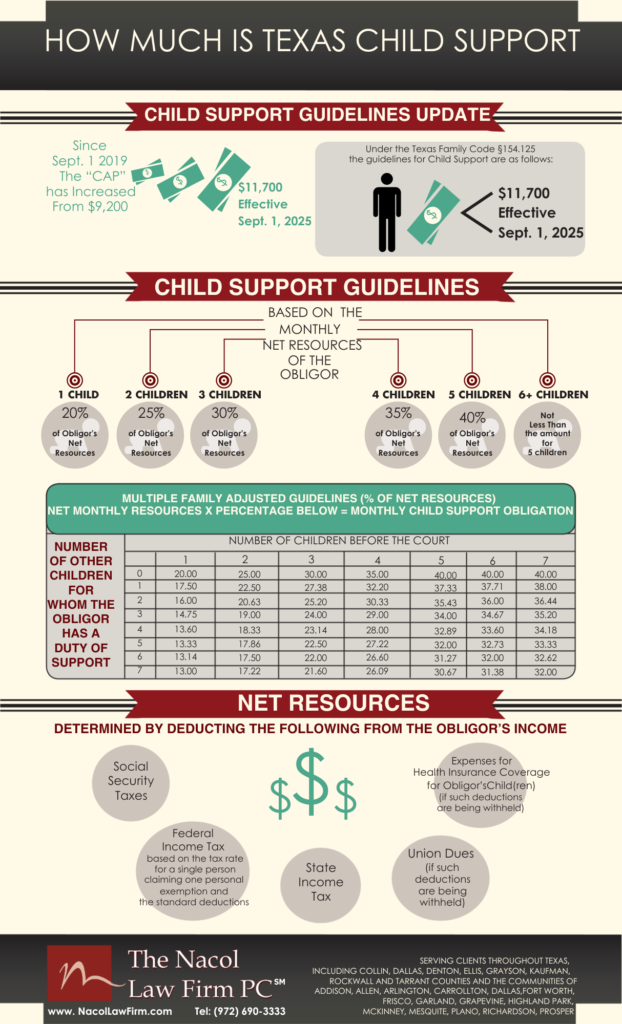
A new cap is effective for all child support orders finalized on or after September 1, 2025
The Texas child support cap increased from $9,200 to $11,700 in net monthly resources for orders finalized on or after September 1, 2025, following legislative changes to the Family Code. This significant adjustment, part of the regular Texas child support guideline review, means higher guideline support amounts for higher-income parents. For example, the new cap results in a maximum monthly payment of $2,340 for one child (20% of $11,700) and up to $4,680 for five or more children (40% of $11,700) under the standard guideline framework.
Texas Family Code §154.125(a)(1) requires that every six years the presumptive amount of net resources to which the child support guidelines apply shall be reviewed and adjusted for inflation by the Texas Office of the Texas Attorney General (OAG). That section sets out the formula for doing so based on the consumer price index. The last adjustment was done in 2019 when an amount of $9200 per month was established.
How does the “cap” work and what could this mean for you? If your net monthly resources are less than $11,700, the child support obligation will not change on Sept. 1. You are under the “current cap” and lower than the “new cap”. All stays the same.
If you are currently going through litigation and your net monthly resources exceeds $11,700 and the Court orders child support prior to September 1, 2025, Texas Child Support Guidelines will mandate that the Court apply the appropriate child support percentage to the first $9,200 in net monthly resources based on the number of children. But, if the Court orders child support after September 1, 2025, it will apply the new appropriate child support percentage to the first $11,700 in net monthly resources.
Child support under the guidelines is determined by applying the applicable percentage, beginning at 20% for one child and increasing incrementally for each additional child, to the net resources amount. If a child support obligor has monthly net resources over $11,700, a party seeking above the guideline’s child support has the burden of proving to the court that additional support should be ordered according to factors set out in Texas Family Code §154.126.
Important to Know: The new “cap” increase of September 1, 2025 will not automatically increase the obligor’s existing child support obligation. Any change in child support standing before September 1, 2025, can only occur through the court with a modification order to increase the child support to the new “Cap” amount of $11,700. After September 1, 2025, any new suit for child support will be subject to the new “cap”.
Please review the Texas Office of the Texas Attorney General (OAG) website for a child support calculator for the new breakdown: https://csapps.oag.texas.gov/monthly-child-support-calculator
The Nacol Law Firm PC
8144 Walnut Hill Lane
Suite #1190
Dallas, Texas 75231
Nacollawfirm.com
NACOL LAW FIRM P.C.
8144 Walnut Hill Lane
Suite 1190
Dallas, Texas 75231
972-690-3333
Office Hours
Monday – Thursday, 8am – 5pm
Friday, 8:30am – 5pm
OUR BLOGS

SEARCH
JOIN OUR NETWORK

Attorney Mark A. Nacol is board certified in Civil Trial Law by the Texas Board of Legal Specialization